

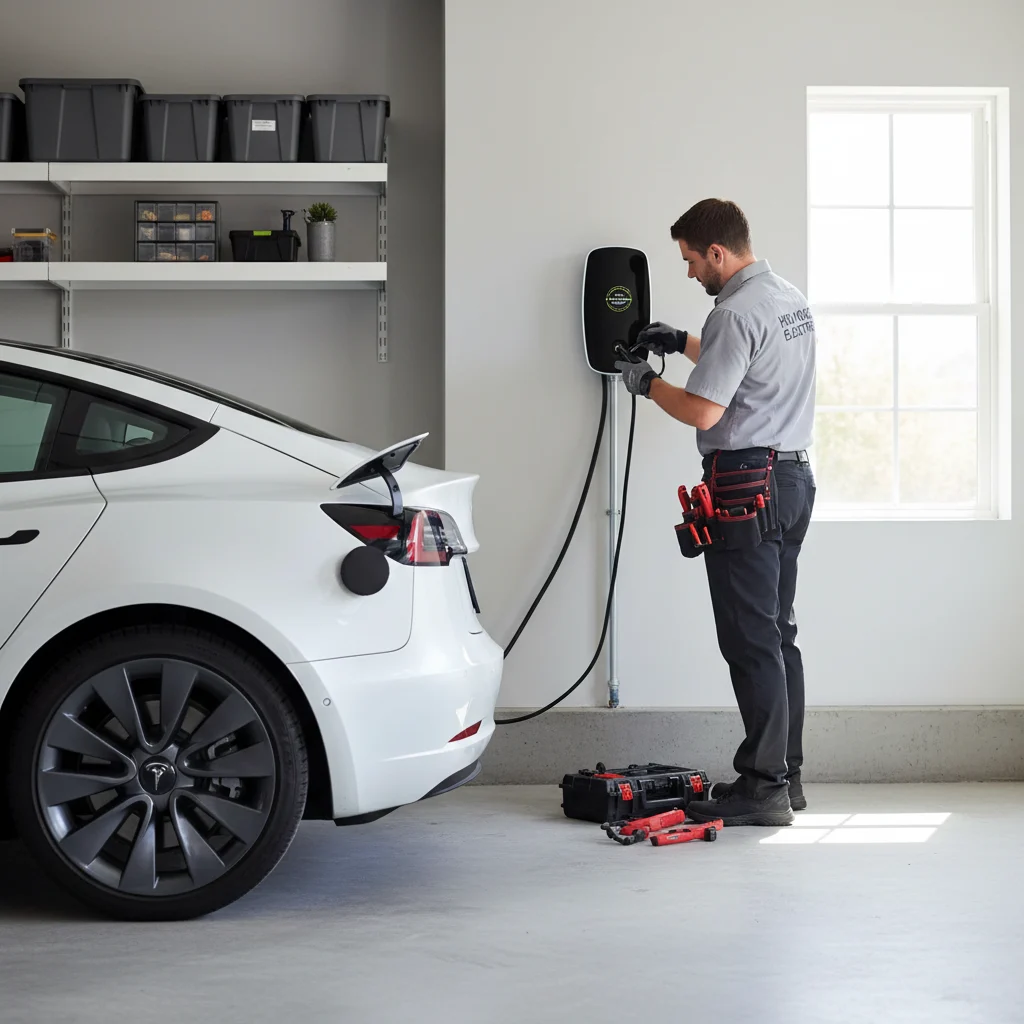
When you delay upgrading your home charging setup, you subject your standard 120-volt household outlets to continuous, heavy electrical draw for dozens of consecutive hours. Standard domestic receptacles were never engineered to sustain continuous full-capacity loads day after day. Over months of nightly use, this unrelenting demand accelerates thermal fatigue within your home wiring, loosens terminal connections, melts outlet faceplates, and frequently trips branch circuit breakers. You wake up repeatedly to find a partially charged battery that disrupts your morning commute, reduces your driving confidence, and compromises battery thermal management during harsh New England winters. Upgrading immediately to a dedicated, properly engineered Level 2 station eliminates these hazardous points of failure while restoring complete charging predictability to your daily routine.
The Critical Risks of Delaying a Dedicated Level 2 EV Charger Installation
Operating an electric vehicle on a standard 120-volt Level 1 cord set poses serious structural and operational headaches if you allow the practice to continue indefinitely. Continuous electrical resistance generates localized heat behind your drywall, gradually degrading wire insulation and stressing older breaker panels. You also forfeit the crucial ability to precondition your vehicle cabin and battery pack from the grid before departure, which directly saps your driving range when temperatures drop across Western Massachusetts. Waiting until an outlet fails or a breaker fuses internally transforms an organized home upgrade into an urgent safety emergency.
- Persistent overheating of 15-amp branch wiring that causes insulation embrittlement and fire hazards
- Chronic state-of-charge deficits that leave you stranded or dependent on expensive commercial stations
- Impaired battery thermal management during freezing temperatures, reducing overall vehicle battery longevity
- Nuisance breaker trips that suddenly interrupt other household appliances sharing unverified branch lines
Understanding Level 1 Versus Level 2 Charging Dynamics and Efficiency
The operational gap between Level 1 and Level 2 charging centers on voltage, amperage, and energy conversion efficiency. A standard 120-volt outlet supplies approximately 1.2 to 1.4 kilowatts of power, providing a meager 3 to 5 miles of range per hour of charging. In contrast, a 240-volt Level 2 circuit operates between 32 and 48 continuous amps, delivering 7.7 to 11.5 kilowatts. This dramatic increase restores 25 to 40 miles of range per hour, fully replenishing an empty battery overnight in four to eight hours.
According to empirical field research published by the Idaho National Laboratory, Level 2 charging delivers significantly superior electrical efficiency compared to Level 1 systems. Because onboard vehicle computers, cooling pumps, and thermal regulation circuits remain energized throughout the charging cycle, a protracted 30-hour Level 1 session wastes substantial energy merely keeping these baseline systems running. Level 2 charging completes the transfer cycle rapidly, reducing baseline parasitic electrical draw and boosting overall grid-to-battery charging efficiency by up to 15 percent.
Electrical Infrastructure Requirements for Residential Stations

Installing a high-output charging station requires a thorough assessment of your primary residential service panel. Modern Level 2 chargers draw continuous current for extended periods, triggering National Electrical Code requirements that govern sustained continuous loads. Under these standards, the electrical circuit must handle 125 percent of the charger continuous operating current. For example, a 48-amp charger demands a dedicated 60-amp double-pole breaker and heavy-gauge copper conductors, such as 6 AWG or 4 AWG wire depending on conduit runs and temperature ratings.
| Charger Current Output | Required Breaker Rating | Recommended Copper Wire Gauge | Typical Added Range Per Hour |
|---|---|---|---|
| 32 Amps | 40 Amps | 8 AWG THHN | 20 to 25 Miles |
| 40 Amps | 50 Amps | 6 AWG THHN / NM-B | 28 to 32 Miles |
| 48 Amps | 60 Amps | 6 AWG THHN (in conduit) | 35 to 40 Miles |
| 80 Amps | 100 Amps | 3 AWG to 2 AWG THHN | 50 to 65 Miles |
Older properties in our region frequently operate on legacy 100-amp service panels that lack the physical space or spare capacity for a 50-amp or 60-amp double-pole breaker. In these instances, our licensed electricians perform precise load calculations to determine if your panel can support the additional demand, install dynamic smart energy monitors, or execute a comprehensive 200-amp service panel upgrade before station mounting begins.
Professional Permitting and Safety Compliance in West Springfield
Handling high-voltage electrical installations yourself or relying on uncertified handymen exposes your property to code violations, insurance denial, and severe electrocution hazards. In the Commonwealth of Massachusetts, electrical installations must adhere strictly to 527 CMR 12.00, which incorporates the National Electrical Code along with distinct state modifications under Article 625. Navigating these mandates demands licensed expertise, municipal permitting, and mandatory formal inspections through the local West Springfield building department.
When you secure professional <a href=
Related
- Efficient EV Charger Installation
- EV Charger Installation in West Springfield
- West Springfield: Your Trusted Electrical Partner
- Contact Us
- Schedule Online
Frequently Asked Questions
How long does a typical Level 2 EV charger installation take?
Most residential Level 2 installations take between three to five hours to complete. Complex runs that require trenching, subpanel installations, or primary service panel upgrades may extend the project duration. A licensed electrician verifies proper operation and local code compliance before completing the job.
Do I need a 200-amp service panel to install a Level 2 charger?
A 200-amp panel is ideal, but it is not always mandatory for every home charging setup. An electrician conducts an official load calculation to evaluate your existing major appliance demands against your incoming capacity. If capacity is limited, smart energy management devices can balance your charger output safely without requiring an immediate main panel replacement.
Is a hardwired installation better than a NEMA 14-50 plug-in unit?
Hardwired installations offer superior weather resistance, eliminate failure points associated with heavy plug receptacles, and permit charging speeds up to 48 amps. Plug-in units provide portability if you relocate, but they max out at 40 continuous amps and require a dedicated GFCI breaker that can sometimes experience nuisance tripping.
Are there local utility incentives for installing an EV charger in West Springfield?
Yes, Eversource and state energy programs frequently provide residential rebates that offset installation and equipment costs. Many programs also offer incentives for enrolling your charger into off-peak charging schedules. Our technicians help identify available regional rebates during the planning process.
Will installing an EV charger increase my property value?
Installing a modern Level 2 charging station adds tangible market appeal and real value to your home. Prospected buyers increasingly prioritize pre-wired electrical infrastructure that supports clean energy technology. A certified, code-compliant installation reassures future buyers that the work meets all state safety standards.
Can I install an outdoor Level 2 charging station if I lack a garage?
You can safely charge your vehicle outdoors by choosing a NEMA 3R or NEMA 4 weatherproof charging station. Certified outdoor units are sealed against heavy rain, snow, freezing ice, and temperature extremes common in Western Massachusetts. Proper mounting to an exterior wall or dedicated ground pedestal ensures reliable year-round performance.
